

-
КАК ПОБЕДИТЬ "ОБОРОТНЕЙ" ВО ВЛАСТИ?
Если вас притесняют рейдеры или в отношении вас сфабриковали дело, вам давно пора ознакомиться с нашим алгоритмом победы!
-

ХОТИТЕ ИМЕТЬ СРЕДСТВО МАССОВОЙ ИНФОРМАЦИИ С ЖУРНАЛИСТАМИ?
Создайте на нашей платформе свой информационный ресурс, который идеально поможет в достижении ваших целей!
ANTARCTICA: WHAT DOES THE "ICE WALL" REALLY HIDE, AND WHY DO WE BELIEVE IN IT?
6 Ноября 2026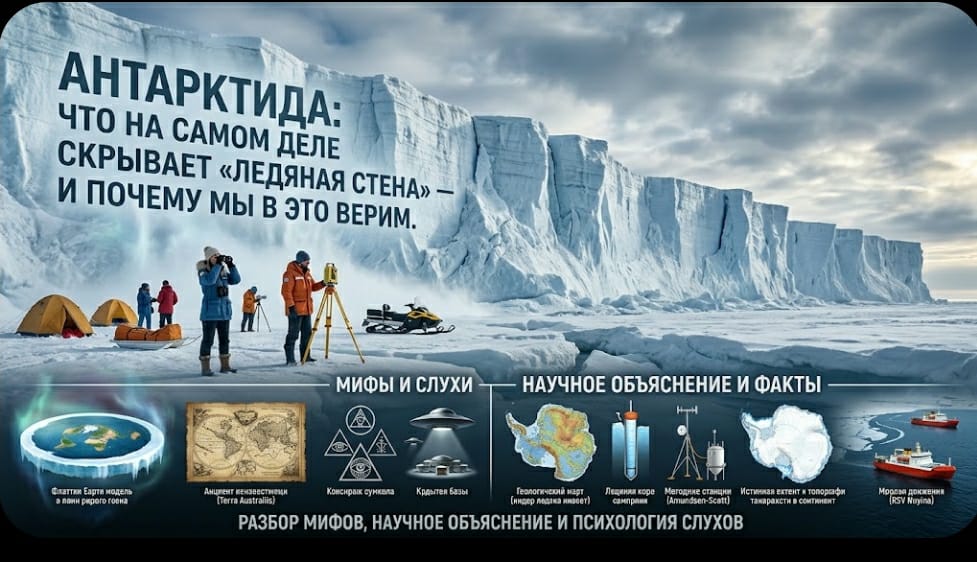
Separating myths from science, and the psychology behind rumors.
INTRODUCTION: THE EDGE OF THE WORLD OR THE EDGE OF REASON?
In my profession I have seen more than a few sensations. I have watched empires rise and fall, watched scientific paradigms that seemed unshakable crumble. But perhaps no story possesses such resilience and such magnetism as the legend of Antarctica's "Ice Wall." This is not merely a conspiracy theory. It is a modern mythology, one that reflects our fear of the unknown, our distrust of authority, and the yearning for wonder that lives in every one of us. Behind the beautiful and at times terrifying tales of a wall concealing other worlds lie real science, real politics, and real human psychology. Let us try to sort out what in this legend is true and what is a product of imagination — and why it endures so stubbornly.
PART ONE: THE BIRTH OF A LEGEND. FROM FLAT EARTH TO A SECRET OCEAN
The roots of this legend reach back into deep antiquity, but its modern form owes its existence to flat-Earth theory. According to this idea, our planet is not a sphere but an enormous disk, at whose edges stands that very giant ice wall, holding back the oceans and hiding unknown lands from us. It is claimed that Antarctica is precisely this wall, encircling the world. This concept cannot withstand the slightest scrutiny from elementary physics and geography, yet it still finds its adherents.
The second, no less important pillar of the legend is the figure of the American admiral Richard Byrd. In 1947 he led a large-scale military expedition called Operation Highjump. Officially its goals were testing equipment and personnel in extreme conditions, as well as mapping. In conspiratorial circles, however, this operation has acquired extraordinary details: supposedly Byrd discovered an entrance to a hollow Earth, encountered an unknown civilization or Nazi bases, and the expedition itself was a secret mission to destroy these forces.
The legend of the "hollow Earth" is a chapter of its own. According to it, beyond the ice wall lie vast cavities where an entire world may exist — Agartha, with its own sun and an advanced civilization. And although Byrd himself never made any such claims, his name has become a veritable brand for authors writing on this subject.
PART TWO: THE DIGITAL AGE. HOW MODERN MYTHS ARE BORN
If the legend once spread through newspapers, books, and hearsay, today its main megaphone is social media. Old maps, blurry satellite images, and — most dangerously — modern content-generation technologies all come into play.
One striking example is the viral videos in which man-made structures, spirals, and entire "lost cities" are supposedly visible beyond the "ice wall." Yet according to checks by independent fact-checkers, these videos were entirely generated by artificial intelligence. Their creators exploit the public's appetite for mystery to rack up views, while a soft-spoken voiceover intones that "the elites" are hiding the truth from us.
Another telling case is a livestream that billionaire Elon Musk called "the first-ever live broadcast of the legendary ice wall." In the footage, boats carrying tourists approached an impressive glacier. In reality, as journalists established, the filming took place not in Antarctica at all but in Patagonia (South America). The author of the broadcast states outright at the end of the recording that he is in Patagonia — but that fragment, of course, was left out of the viral edit.
PART THREE: THE SCIENTIFIC VIEW. WHAT IS THE "WALL," REALLY?
While conspiracy theorists search for secret passages, glaciologists and geophysicists offer a thoroughly prosaic — yet no less captivating — explanation. The "ice wall" that travelers see as they approach Antarctica by ship is not the edge of the world but an ice shelf. The most famous of these is the Ross Ice Shelf.
Picture a floating mass of ice comparable in area to France. Its ocean-facing edge does indeed form a sheer wall. Its height above the water can reach 50 meters and, by some estimates, more; the submerged portion descends hundreds of meters into the depths. To an observer on a ship's deck, it looks like an endless, insurmountable barrier. It is this real, majestic, and dangerous natural object that became the prototype for all mystical "walls."
Science also explains what lies beyond this wall. There are no cavities, no cities. There lies a continent covered by an ice sheet. Its thickness in some areas reaches 4.7 kilometers. Beneath the weight of this ice lie bedrock, lakes, and terrain that scientists study using radar and seismic methods. This is not a secret world but a complex and fragile ecosystem that demands protection.
PART FOUR: WHY DO WE BELIEVE? PSYCHOLOGY AND POLITICS
If science explains everything so clearly, why does the legend survive? The answer lies in psychology and geopolitics.
1. Restricted information. Antarctica is a unique region governed under the 1959 Antarctic Treaty, which secured its status as a demilitarized zone intended exclusively for peaceful and scientific purposes. The strict regulation of visits and economic activity creates a sense of a "zone of silence." To an inquisitive mind, a prohibition or restriction automatically becomes grounds for suspecting the concealment of something grand.
2. Fear of the unknown. Antarctica is one of the last truly harsh and little-studied corners of the planet. It embodies the "blank spot" on the map that human imagination seeks to fill with monsters, just as in olden times the edges of maps were filled with dragons.
3. Distrust of institutions. In an era when trust in governments, the media, and official science has been eroded, conspiracy theories become for many a way to explain a complex world. The idea that "everything is being hidden" offers the illusion of understanding and of belonging to "secret knowledge."
To this is added confirmation bias: a person inclined to believe conspiracy versions more readily notices and remembers any "strange" footage but ignores its scientific explanations. Thus the legend feeds on itself.
CONCLUSION: THE WALL WE BUILT OURSELVES
So what does the ice wall in Antarctica hide? The answer, in my view, is at once simple and complex. It hides nothing supernatural. It hides Antarctica itself — a gigantic, cold, beautiful, and vulnerable continent. Beyond it there is no Agartha, no alien bases, no secret Nazi bunkers. Beyond it lies the last untouched frontier of the Earth, preserving the planet's climatic history and colossal reserves of fresh water.
The legend of the "Ice Wall" is not so much a story about Antarctica as a mirror reflecting our own society: its curiosity and its ignorance, its longing for wonder and its fear of it, its credulity and its cynicism. The real wall runs not through the glaciers of Antarctica but through our perception — between the willingness to accept complex scientific truths and the temptation of simple but false answers. And the louder the voices crying out about sensations become, the more important it is to remember the quiet, painstaking work of those who study this icy world rather than invent it.
Ruslan CHUMAKOV
Special Correspondent-Criminologist,
World Community magazine


Д.С. ДАРМОДЕХИН;
А.А. ГАЯМЯН;
1. Скопируйте ссылку: http://compronet.info
2. В меню вашего браузера Инструменты (Tools) выберите Настройки (Options)
3. В открытом окне, выберите вкладку Основные (General)
4. Вставьте скопированную ссылку в строку Домашняя страница (Home page)
5. Нажмите ОК