

-
КАК ПОБЕДИТЬ "ОБОРОТНЕЙ" ВО ВЛАСТИ?
Если вас притесняют рейдеры или в отношении вас сфабриковали дело, вам давно пора ознакомиться с нашим алгоритмом победы!
-

ХОТИТЕ ИМЕТЬ СРЕДСТВО МАССОВОЙ ИНФОРМАЦИИ С ЖУРНАЛИСТАМИ?
Создайте на нашей платформе свой информационный ресурс, который идеально поможет в достижении ваших целей!
LIEUTENANT SHUGAEV
19 Сентября 2026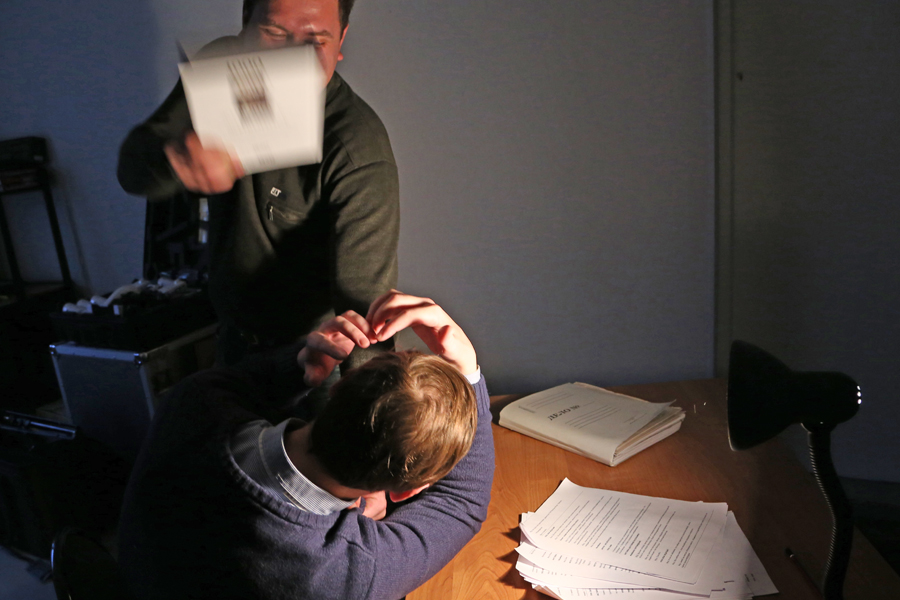
Источник картинки (не коммерческое использование)
The spring of 1945 smelled of gunpowder and lilac. Alexander Shugaev stepped off the train onto the platform at Bargvinsk, and his knees trembled—not from fatigue, but from being unaccustomed to standing on ground that did not shudder with explosions. Behind him lay four years of war, two wounds, and a soldier’s tunic burned through in three places. Ahead waited a peaceful life.
The city greeted him with the ruins of factory buildings and bread lines. Shugaev walked along the street, greedily breathing in the air. Smoke, coal, wet asphalt… Victory. He had come back alive. Now one could build, grow, restore.
A week later he was summoned to the city committee of the Komsomol.
“Comrade Shugaev,” the secretary looked at him with respect, “the Party and the Komsomol need good cadres. We propose that you join the NKVD. The work is responsible and honorable. You will fight the enemies of the people.”
Shugaev straightened up. Enemy… He knew that word well. He had seen the enemy face-to-face, in the crosshairs of a rifle, in a burning tank. If the Party said the enemy remained, then so it was. He must finish him off, defend the Motherland, its ideals, help it live and develop in the new life.
“I agree,” he rapped out, almost without thinking. “For the Motherland and the Party, I am ready for anything!”
And so Lieutenant Shugaev became an operational officer.
The awakening came a few months later.
He sat in a basement on a stool and watched as the interrogator—Senior Lieutenant Krivtsov—methodically, without malice, like a carpenter driving nails, struck the man under interrogation in the kidneys. The man—an already middle-aged accountant from the bread factory—wheezed and insisted he was innocent.
“Confess, you bastard,” Krivtsov said. “You’ll confess anyway. Where can you go?”
The accountant confessed on the third day. He confessed that he was an agent of British intelligence, recruited in 1937 through a cousin living in London, though no such cousin existed. He himself had said as much more than once before, but no one had listened.
Shugaev left the basement, climbed the stairs, and stood for a long time on the porch, looking into the gray sky. His hands were shaking. He thought: this is a mistake. It happens. The mistake of individual people. The whole system cannot be like this.
But the system was exactly like that.
Six months later he already remembered the night executions. He knew how a volley sounded in a basement. It was muffled, as if someone had dropped a sack of potatoes. He already knew how special troikas signed sentences. It was done very quickly. He already knew, too, how people were taken away on denunciations, where the pretext was a careless word or a sidelong glance.
And then Shugaev understood: he could not and did not want to take part in it.
But where could he go? Resign? They would not let him go peacefully. They would say: why did you come? What don’t you like? Maybe you’re an enemy yourself? A yellow ticket, expulsion from the Komsomol—that was the best case. The worst—a criminal case, the camps, prisoner transports.
Shugaev thought for a month. Then he went to his superiors.
“Comrade Major, I request a transfer as operational supervisor to the Red Hammer factory.”
The major raised his eyebrows:
“Why?”
“I want to be closer to the working class. Operational work in production is especially important. Enemies always try to penetrate there first.”
The major agreed. Shugaev exhaled.
The factory smelled of metal and machine oil. Shugaev walked through the shops, talked with workers, monitored the security regime. He told himself: that’s it now. Now I simply keep an eye on the operational situation. No basements. No executions.
But two months later he was summoned to the directorate.
“Comrade Lieutenant,” the head of the department looked at him coldly, “are you asleep there or what? Why aren’t you exposing enemy conspiracies?”
Shugaev went cold.
“There aren’t any yet.”
“What do you mean, there aren’t any? There can’t be a factory like this without conspiracies. No wreckers, no saboteurs, no enemy elements. That doesn’t happen! That means you’re working badly! Find them, or your professionalism will be called into question!”
Shugaev went outside and lit a cigarette. Now he was in for it! Out of the frying pan into the fire! Now they demanded heads from him. They demanded that he find enemies where there were none. Or appoint them. And if he found no one, soon they would “find” him.
At night he did not sleep. He lay on his cot in the dormitory and stared at the ceiling. What to do? Refuse? Big problems would begin. Appoint someone, as other colleagues did? But that was betrayal! What then should he do? Was he at a dead end?
He thought for a day, two, a week. And he came up with an idea.
A few months later, he submitted a report requesting discharge in connection with his enrollment in the full-time department of the law faculty of Bargvinsk State University.
At the directorate they were surprised.
“Why do you need this?” the personnel officer asked. “It would have been enough to submit a report of intent, and you would have been accepted under a special referral, without exams. You could have studied by correspondence.”
“I wanted to do it all myself,” Shugaev said. “To prove to myself and to others that I could manage. And I chose full-time specifically so I would study five years instead of six. I’ll leave the service temporarily, gain the necessary knowledge, and return. With new strength, new skills.”
The personnel officer looked at him with respect.
“Well, look here. It’s your business. Since you’re a Komsomol member, decide for yourself.”
The authorities approved. People began talking about Shugaev at Komsomol and Party meetings. A true Chekist. He had not feared difficulties. He had gone to study so as to return and work even better. An example for the youth.
Former colleagues told Shugaev about this, and he kept silent. He entered the first year, received a student ID, and sat down to his textbooks.
Five years flew by quickly. He studied the theory of state and law, history, Latin, criminalistics. Shugaev delved into every article, every nuance. He knew that law was not what he had had to witness in the basements of the NKVD. Law was something altogether different. It was what should be the foundation of life.
In his fifth year he passed the state exams. He received his diploma. At job assignment, he was offered to remain at the department, to enter graduate school. He refused.
The NKVD was waiting for him. They even sent him a letter: come back, we remember you.
Shugaev did not return.
He went to the prosecutor’s office.
In the personnel department of the prosecutor’s office, they said to him:
“A young specialist, excellent marks. Why us?”
“I want to work according to the law,” Shugaev answered.
The head of the department looked at him attentively. He was silent for a long time.
“Well then,” he said at last. “Work.”
Shugaev went outside. Bargvinsk was rebuilding, growing, turning green. The spring was warm, and the lilac smelled just as it had in ’45. Only now he knew the price of that smell.
He walked along the street and thought: I could not stop what was. But I can refuse to take part in what will be, if it turns out to be the same. I can work so that the law is not a club but a shield. And I will.
And he walked toward a new life. One in which there were no prison dungeons, no torture cellars, no beaten-out testimony, no appointed spies and enemies of the people.
Author: Dmitry DARMODEKHIN


Д.С. ДАРМОДЕХИН;
А.А. ГАЯМЯН;
1. Скопируйте ссылку: http://compronet.info
2. В меню вашего браузера Инструменты (Tools) выберите Настройки (Options)
3. В открытом окне, выберите вкладку Основные (General)
4. Вставьте скопированную ссылку в строку Домашняя страница (Home page)
5. Нажмите ОК